Blue Heart Robotics Publications

Your Turn in
Robotics

Your one-stop guide to robotics, taking you from complete beginner to expert level.

A robot is built from three fields at once: mechanical, electronics and computer science. This book teaches all three, and every chapter ends with exercises you build yourself.

  • Mechanical
  • Electronics
  • Computer science
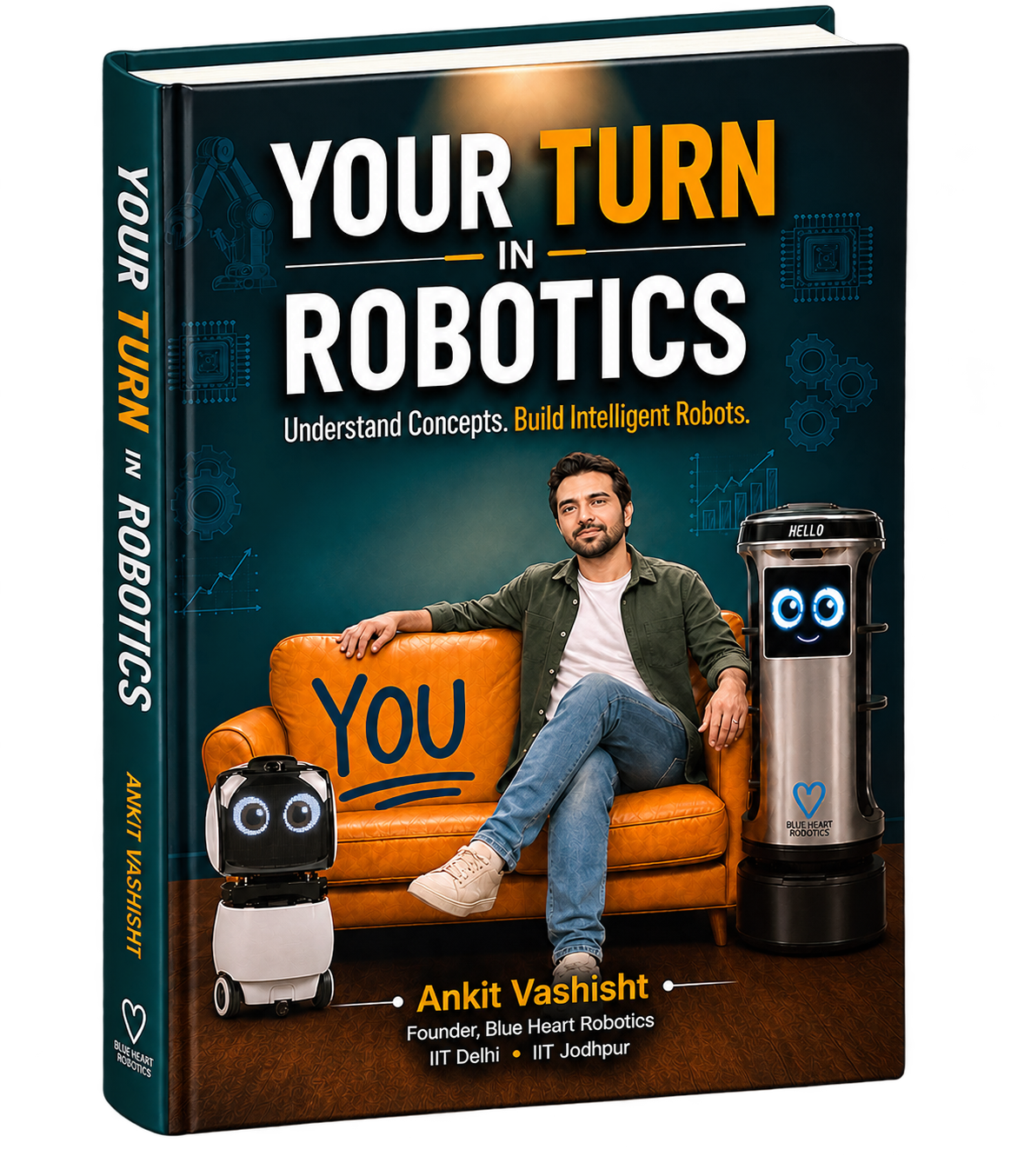
Cover of Your Turn in Robotics by Ankit Vashisht
Author from IIT Delhi Exercises in every chapter Beginner to expert

Three disciplines · One machine

One robot needs three fields

Mechanical

Motors, motion, gears and kinematics.

Chapters 12

Electronics

Circuits, components, controllers and sensors.

Chapters 34

Computer science

Programming, vision, language and AI.

Chapters 567

Together they give a robot that moves, senses and thinks.

Inside the book

Contents

From the first motor to large language models, in the order you will build it.

  • 8Chapters
  • 440+Pages
  • 3Fields

Prologue

00Introduction8 topicsp. 1
  • 0.1 The Boy from Prahladpur1
  • 0.2 The Pokemon That Never Came2
  • 0.3 What is a Machine?3
  • 0.4 What is a Robot?5
  • 0.5 Types of Robots8
  • 0.6 The Road Here9
  • 0.7 What This Book Will and Won't Do12
  • Exercises13

The three parts

Motors, motion, gears and kinematics.

01The Muscles of a Robot9 topicsp. 15
  • 1.1 What are Actuators16
  • 1.2 Force, Mass, and Motion18
  • 1.3 DC Motors22
  • 1.4 Servo Motors30
  • 1.5 Stepper Motors34
  • 1.6 Wheels and Motion39
  • 1.7 Differential Drive and Wheel Odometry43
  • 1.8 Choosing the Right Actuator53
  • Exercises55
02How a Robot Moves7 topicsp. 59
  • 2.1 Physics and Its Branches60
  • 2.2 Mechanisms, Links, and Joints64
  • 2.3 Common Mechanisms in Robotics71
  • 2.4 Gears78
  • 2.5 Matrices and Transformations84
  • 2.6 Forward and Inverse Kinematics94
  • Exercises101

Back matter

ADerivations3 topicsp. 435
  • A.1 Wheel Odometry for a Turning Robot435
  • A.2 Inverse Kinematics: Finding θ1437
  • A.3 Recovering R and t from the Essential Matrix438
BAnswers to Exercises8 topicsp. 441
  • Chapter 0441
  • Chapter 1442
  • Chapter 2442
  • Chapter 3443
  • Chapter 4444
  • Chapter 5445
  • Chapter 6445
  • Chapter 7446

Learn by doing

Every chapter ends with something to build

  1. Step 1

    Read

    Learn the idea in plain words, with the formulas explained as you go.

  2. Step 2

    Build

    Do the exercises at the end of the chapter and put the theory into practice.

  3. Step 3

    Check

    Compare your work with the answers in Appendix B.

Meet the author

Learn robotics from someone who has built it

A robot needs mechanical, electronics and computer science. Ankit is trained in all three, and has built real robots with them.

He founded Blue Heart Robotics and built two robots himself: HAPPY, an educational robot, and MARK, a marketing robot. So when this book explains how a robot moves, senses and thinks, it explains what he has actually done.

  • IIT DelhiPhD scholar, Electrical Engineering
  • IIT JodhpurM.Tech, Computer Science
  • AIIMS DelhiResearch collaborator
Why trust him?

He has built what he teaches

His training and research come from IIT Delhi, IIT Jodhpur and AIIMS Delhi, and he has turned that knowledge into two working robots.

Why read this book?

Robotics, told as a story

The book is written in a creative way, with every concept tied to a robot he built, so even the hard ideas are easy to follow.

Begin your robotics journey today

Your Turn in Robotics

by Ankit Vashisht

  • One-stop solution to understand all about robotics
  • Mechanical, electronics and computer science in one book
  • Exercises in every chapter, with answers in Appendix B
Buy now

Questions, answered

Who is this book for?

Students, teachers and self-learners who want to build a complete robot. It starts from what a machine is, so you do not need earlier experience.

Do I need electronics knowledge first?

No. Chapter 3 begins with voltage and current and builds up to transistors and relays.

Does it include programming?

Yes. Chapter 5 teaches programming from the start, and Chapters 6 and 7 move on to vision, language and deep learning.

How will I receive it?

Delivery options are shown at checkout once the book is on sale.

Is the payment secure?

Payment is processed by a secure payment gateway. We never see or store your card details.